
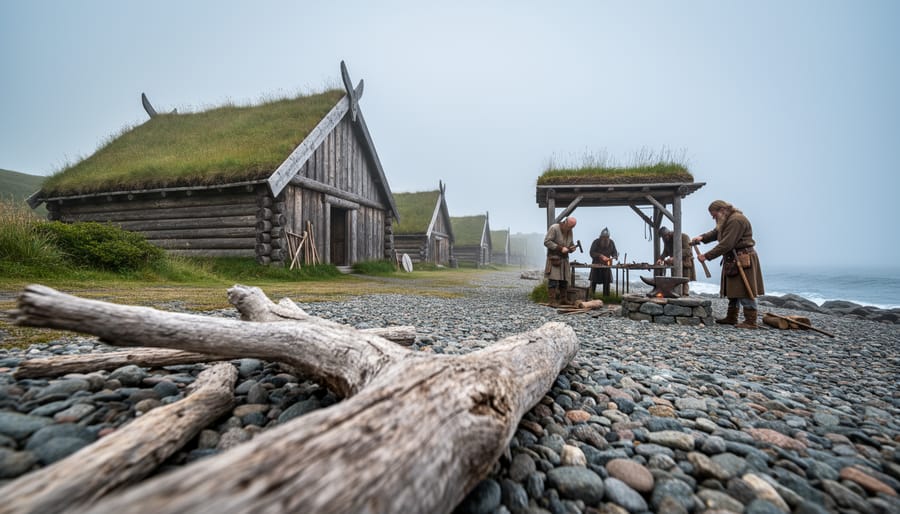
Around the year 1000 CE, Norse voyagers from Greenland built the first European settlement in North America at what we now call the L’Anse aux Meadows site on Newfoundland’s northern tip. This Norse settlement in Newfoundland predates Columbus by nearly 500 years, rewriting the narrative of transatlantic contact and proving that Viking sagas describing lands west of Greenland weren’t mere mythology.
The discovery of this settlement in 1960 by Norwegian explorer Helge Ingstad and archaeologist Anne Stine Ingstad transformed our understanding of Viking exploration. Here, archaeologists uncovered irrefutable evidence: eight timber-framed buildings with sod walls, a forge for producing iron nails, and artifacts unmistakably Norse in origin. Radiocarbon dating placed the occupation between 990 and 1050 CE, confirming that these structures aligned with the timeline described in the Icelandic sagas about Leif Erikson’s journey to Vinland.
What makes this site extraordinary isn’t just its age. The Norse didn’t simply land and leave. They built a fully functioning base camp complete with workshops, living quarters, and storage facilities. The presence of butternut wood, which grows hundreds of miles south of L’Anse aux Meadows, suggests the Vikings explored far beyond this northern outpost. Yet the settlement was short-lived, abandoned after only a few years for reasons scholars still debate.
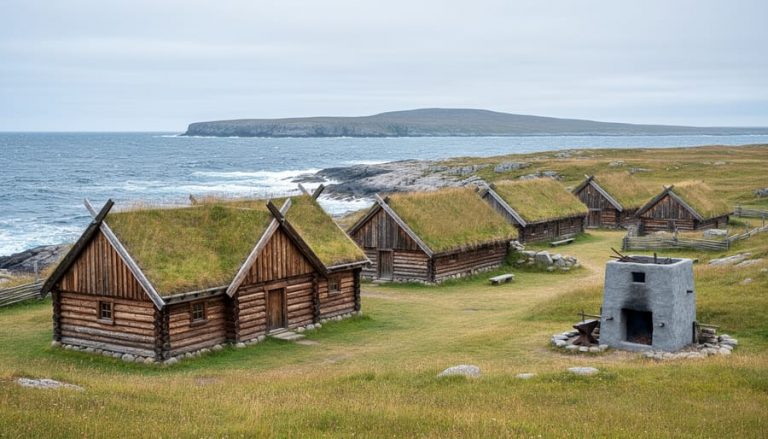
Today, L’Anse aux Meadows stands as a UNESCO World Heritage Site where you can walk among reconstructed Norse buildings, watch costumed interpreters demonstrate Viking crafts, and stand on the same windswept coast where European and Indigenous peoples first encountered one another. Whether you’re an archaeology enthusiast seeking to understand early transatlantic contact or a traveler planning a heritage tour of Atlantic Canada, this remote corner of Newfoundland offers a tangible connection to one of history’s most remarkable journeys.
The Discovery That Changed History
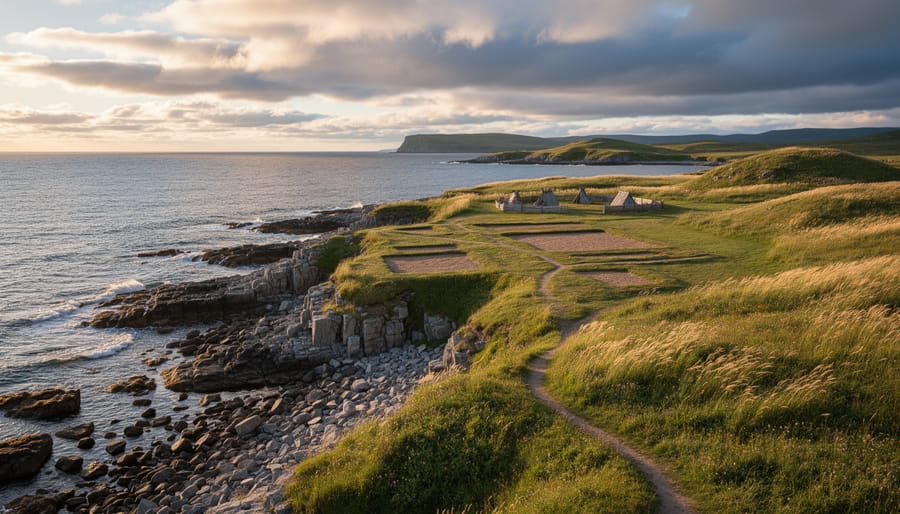
In 1960, Norwegian explorer Helge Ingstad arrived in northern Newfoundland with a theory that most scholars dismissed: the Viking sagas describing voyages to “Vinland” weren’t just mythology. He believed these stories documented actual Norse settlements somewhere along North America’s eastern coast, and he was determined to find proof.
Ingstad’s search led him to a remote fishing village called L’Anse aux Meadows, where locals pointed out unusual overgrown ridges near Black Duck Brook. When he examined these earthen mounds with his wife, archaeologist Anne Stine Ingstad, they recognized something extraordinary. The rectangular formations didn’t match Indigenous building traditions. They looked suspiciously like Norse longhouse foundations Anne Stine had excavated in Greenland and Iceland.
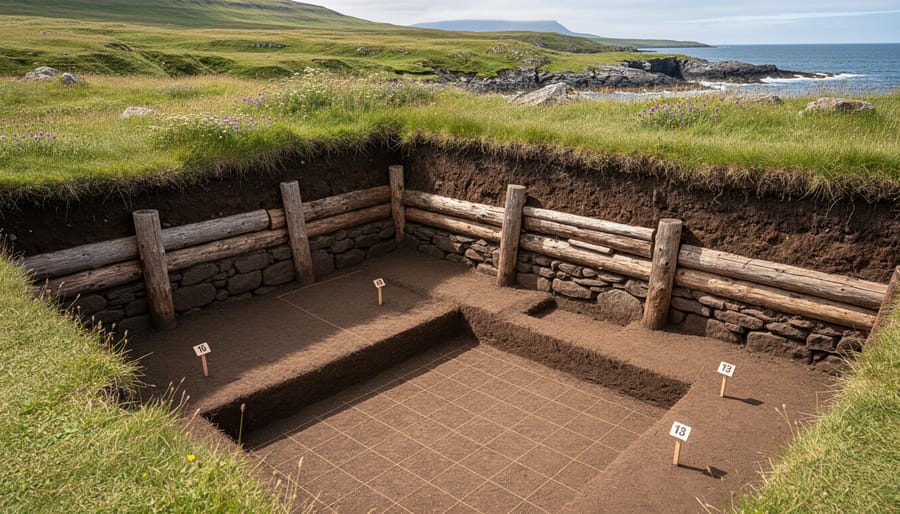
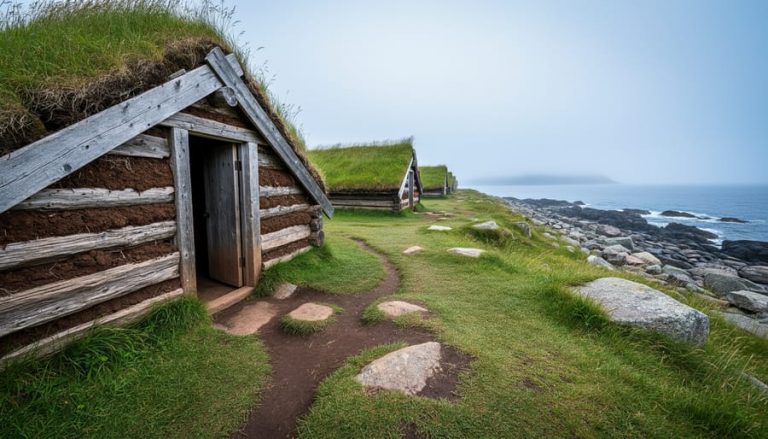
What followed were eight seasons of meticulous excavation that would rewrite North American history. Anne Stine led the archaeological work, uncovering the remains of eight timber-framed buildings with walls made from layers of turf. The structures followed Norse architectural patterns, with a distinctive central hearth design and side benches for sleeping. But physical similarities weren’t enough to prove Norse origin.
The breakthrough came from artifacts that couldn’t be explained any other way. Excavators found a bronze ring-headed pin, a type worn exclusively by Norse people to fasten their cloaks. They discovered a stone oil lamp identical to those used in Iceland and Greenland. Most crucially, they uncovered evidence of ironworking, a technology Indigenous peoples in this region didn’t possess at that time.
The iron slag found at the site contained bog iron, processed using Scandinavian smelting techniques. Chemical analysis of the slag matched Norse metalworking methods, not later European practices. Carbon-14 dating of burned wood and peat confirmed occupation around 1000 CE, precisely matching the timeline of Leif Erikson’s voyages described in Icelandic sagas.
By 1968, the archaeological community accepted what seemed impossible just years earlier: Vikings had established a settlement in North America nearly five centuries before Columbus. The Norse settlement in Newfoundland wasn’t legend. It was documented fact, proven by soil and artifacts that couldn’t lie about their Scandinavian origins.
What the Norse Actually Built in Newfoundland
The Ironworking Evidence
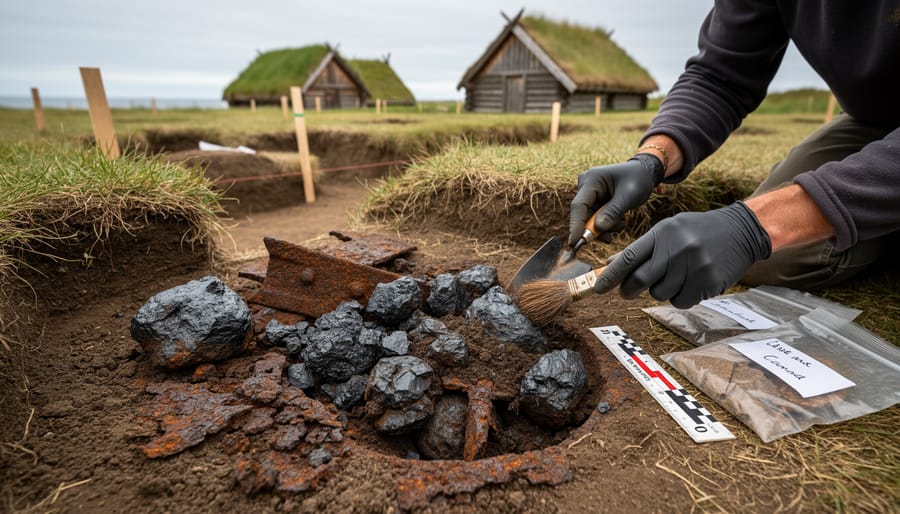
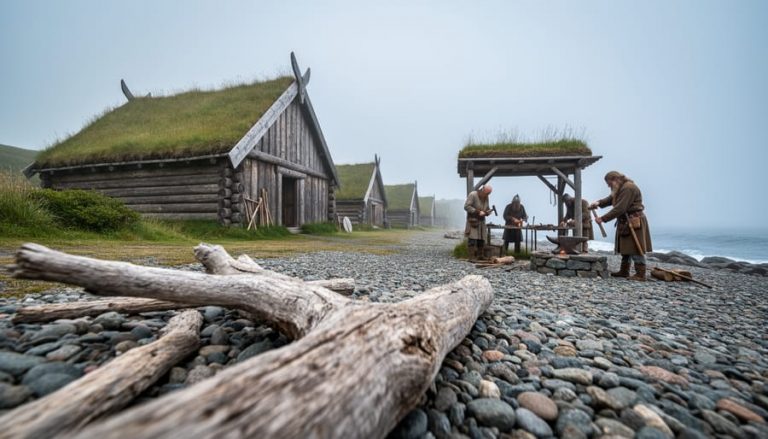
The iron slag found at L’Anse aux Meadows was the smoking gun that proved Vikings, not Indigenous peoples, built this settlement. When archaeologists uncovered the remains of a stone furnace and scattered pieces of iron bloom, the spongy mass produced when smelting bog iron ore, they’d discovered something Indigenous North Americans never developed: iron metallurgy.
The Norse needed iron constantly: for ship repairs, tools, and nails. At L’Anse aux Meadows, they set up a small-scale smelting operation using bog iron gathered from nearby wetlands. The process was straightforward but labor-intensive. Workers collected iron-rich mud, roasted it to concentrate the ore, then heated it in a stone furnace with charcoal. The resulting bloom had to be hammered repeatedly to remove impurities and shape it into usable iron.
What makes this evidence so definitive? The chemical composition of the slag matches Norse ironworking from Iceland and Greenland, not any other metalworking tradition. The furnace design, the ratio of slag to bloom, even the charcoal species used, all point unmistakably to Norse techniques from around 1000 CE.
The modest scale tells us something important about their intentions. This wasn’t an industrial operation for mass production. Instead, the Norse were making just enough iron for essential repairs and tool maintenance. They were running a remote outpost, not establishing a permanent colony, a base camp for exploring further south, not the final destination itself.
Living Quarters and Daily Life
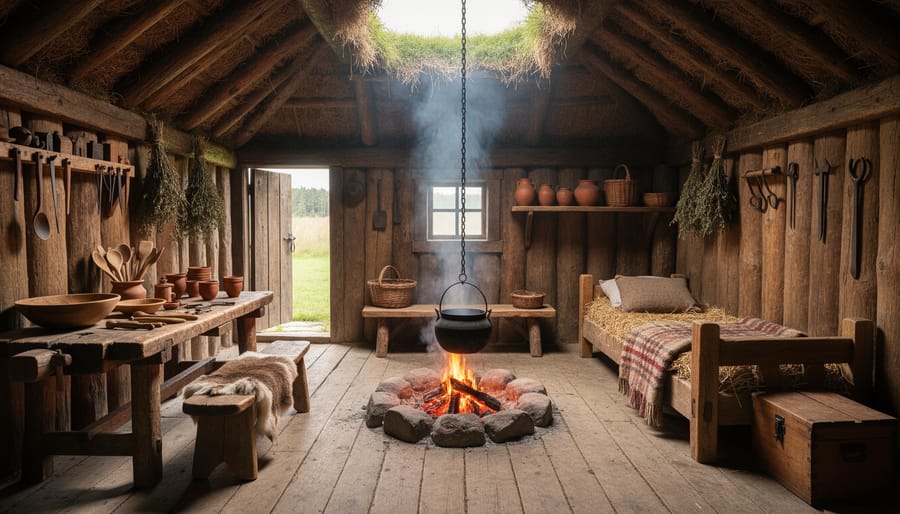
The residential buildings at L’Anse aux Meadows paint a vivid picture of a small but organized Norse community. Archaeologists identified three dwelling halls, each following the characteristic Norse longhouse design with central hearths and raised benches along the walls where inhabitants slept and worked. The largest hall measured approximately 15 by 7.5 meters, spacious enough for several families or a crew of workers.
Artifact evidence suggests 70 to 90 people occupied the settlement at its peak, though not necessarily all year round. The finds tell us these weren’t just rough explorers camping temporarily. Women lived here alongside men, as proven by bone needles, spindle whorls for wool processing, and sewing equipment scattered throughout the residential areas. The Norse brought their domestic routines across the Atlantic, spinning thread, weaving fabric, and mending clothes just as they would in Iceland or Greenland.
Cooking happened over stone-lined hearths where charred food remains included fish, caribou, and wild berries. Storage pits near the hearths held supplies for cooking and preservation. Personal items discovered in living quarters included a whetstone for sharpening tools, gaming pieces carved from bone, and a bronze cloak pin, small but telling details about how these settlers filled their evenings.
The artifacts show skilled craftspeople at work: woodworkers, textile workers, and tool makers maintaining a functioning household far from home. These weren’t temporary camps but functioning Norse households attempting to establish a foothold in Newfoundland.
Why the Norse Chose This Location
The northern tip of Newfoundland’s Great Northern Peninsula wasn’t a random choice. The Norse selected L’Anse aux Meadows for a cluster of practical advantages that made it ideal as a forward base for exploration and resource gathering.
First, the location offered safe harbor. Black Duck Brook flows into a protected bay where Norse knarrs could beach for repairs and loading. The shallow, sheltered waters provided exactly what these oceangoing vessels needed after crossing the North Atlantic, and the site sits at roughly the same latitude as Bergen, Norway, making east-west navigation relatively straightforward using the methods Norse sailors had mastered.
Resource availability drove the decision just as much as maritime concerns. The surrounding area provided everything needed for ship repair and ironworking: timber from black spruce forests, bog iron deposits in wetlands nearby, and sod for constructing insulated buildings using familiar Norse techniques. Archaeological evidence shows they immediately set up a bloomery furnace, suggesting iron production was a priority, not an afterthought.
The site also functioned as a staging point for exploring further south. While the sagas describe Vinland as a land of wild grapes and mild winters, nothing about northern Newfoundland matches that description. L’Anse aux Meadows appears to have served as a gateway rather than the final destination, a place to overwinter, repair ships, process resources like timber and iron, and launch expeditions to more temperate regions.
Position mattered strategically too. The settlement sits where the Labrador Current meets the Gulf of St. Lawrence, placing it at a natural crossroads for anyone moving down the coast. From this base, Norse crews could explore the St. Lawrence waterway or continue south along the Atlantic shore, exactly the kind of reconnaissance pattern the archaeological footprint suggests: short-term occupation, shipyard facilities, resource processing, but limited residential development.
How Long Did the Norse Stay?
The archaeological evidence suggests the Norse occupied L’Anse aux Meadows for a surprisingly brief period, likely no more than a decade, and possibly just a few years around 1000 CE. Unlike the centuries-long Norse settlements in Greenland and Iceland, this Newfoundland outpost shows minimal accumulation of the everyday debris and structural repairs that mark permanent habitation. The turf walls never needed replacing, and the midden heaps remained modest compared to sites where people lived for generations.
The nature of artifacts found on site reinforces this interpretation. Excavators discovered few personal possessions, broken tools, or worn-out equipment, the kind of accumulated material culture you’d expect from long-term residents. Instead, the finds suggest a working camp: boat repair materials, iron production waste, and functional items for processing resources. The buildings themselves, while substantial, lack features like dedicated storage cellars or the interior modifications that emerge when families settle in for multiple generations.
Several factors likely drove the Norse to abandon Newfoundland. Distance played a crucial role, the journey from Greenland required open-ocean crossings of over 1,500 nautical miles, making regular supply runs perilous and communication nearly impossible. The local Indigenous populations, whom the sagas call Skrælings, may have proven hostile enough to make sustained settlement untenable. Archaeological evidence elsewhere in Atlantic Canada suggests the Norse encountered resistance during resource-gathering expeditions.
Economic calculations probably sealed the outpost’s fate. The resources available, timber, iron ore, wild grapes further south, didn’t justify the enormous effort required to maintain a North American foothold when Greenland and Iceland still offered expansion opportunities closer to home. Without finding precious metals or establishing profitable trade networks, L’Anse aux Meadows remained a distant experiment the Norse chose not to continue.
Connections to the Viking Sagas
The discovery at L’Anse aux Meadows transformed the Icelandic sagas from mythic tales into historical documents. Written down in the 13th century but recounting events from around 1000 CE, the Saga of the Greenlanders and Erik the Red’s Saga describe Leif Erikson’s voyages to a land he called Vinland, a place with timber, wild grapes, and salmon. For centuries, scholars dismissed these accounts as folklore. The Newfoundland site proved they had a basis in reality.
The archaeological evidence aligns remarkably with saga descriptions in several ways. The sagas mention timber-framed buildings with turf walls, exactly matching what excavators found. They describe ironworking and boat repair, both confirmed by artifact analysis. The location fits saga references to sailing west from Greenland and finding land with good grazing and resources. Even details like the presence of butternuts (a species found south of Newfoundland) among the artifacts support saga claims of further exploration beyond the settlement itself.
Yet significant mysteries persist. The sagas’ “Vinland” suggests wine grapes, which don’t grow this far north. Either the Norse ventured much farther south than L’Anse aux Meadows, the term referred to different berries, or later copyists embellished the accounts. The sagas describe conflicts with Indigenous peoples they called Skrælings, but archaeological evidence of such encounters remains limited. Questions about how many voyages occurred, who exactly led them, and whether other settlements existed continue to drive research connecting UNESCO & history.
What’s certain is that oral traditions preserved across generations contained genuine geographical and cultural details, validated a millennium later by careful excavation.
Visiting L’Anse aux Meadows Today
Planning Your Visit: A Detailed Itinerary
A full day at L’Anse aux Meadows gives you time to absorb what happened here a millennium ago. Arrive when the visitor center opens at 9 AM to watch the orientation film before the tour groups arrive. This twenty-minute documentary sets the archaeological context and explains what to see across the site.
Join the 10 AM guided tour led by Parks Canada interpreters who bring the settlement to life with stories drawn from both archaeology and the sagas. They’ll walk you through the reconstructed sod buildings where you can feel the weight of turf walls and imagine smoke rising from central hearths. The tour covers the excavated house sites, the ironworking area, and the shoreline where Norse boats would have beached. Budget ninety minutes for this essential experience.
After lunch at the small café, explore the walking trails independently. The 1.5-kilometer coastal path offers stunning views across Epaves Bay and connects you to the landscape the Norse encountered: windswept headlands, sheltered coves, and the kind of bog iron deposits they needed for tool repair. Allow an hour for this contemplative walk.
Return to the visitor center by 2 PM to examine the artifact displays at your own pace. The iron boat nail, the bronze cloak pin, and the bone needles represent the only confirmed Norse materials from North America. Study the stratigraphic diagrams showing how archaeologists distinguished Norse layers from earlier Indigenous occupation.
Plan your visit for June through early September when the site operates full services and costumed interpreters demonstrate Norse crafts in the reconstructed buildings. July and August bring peak crowds but also longer hours and special programming. If you prefer solitude, visit in early June or September when you might have the trails largely to yourself, though some programs may be reduced.
Expert Perspectives on the Norse Settlement
Archaeologists continue to refine their understanding of the Norse settlement in Newfoundland, with new analysis techniques revealing details the original excavators couldn’t have imagined. Dr. Birgitta Wallace, who spent decades studying L’Anse aux Meadows artifacts at Parks Canada, has emphasized how sophisticated the Norse operation was despite its brief duration. Her analysis of spatial patterns and tool marks suggests a well-organized expedition with clear division of labor, not a desperate scramble for survival.
Recent developments in dendrochronology and radiocarbon dating have narrowed the occupation window. Researchers now believe the settlement functioned for just a few years in the early 11th century, possibly as few as ten years total. This brevity raises intriguing questions about Norse intentions. Was L’Anse aux Meadows always meant as a temporary staging post for exploration farther south, or did conditions force an earlier-than-planned departure?
The Norse settlement in Newfoundland represents a fundamentally different model of contact than what followed centuries later, an experiment that succeeded on its own terms but didn’t lead to permanent colonization.
Site interpreters at the UNESCO World Heritage Site report that visitors often ask why the Norse didn’t stay longer. The answer likely involves a combination of factors: hostile encounters with Indigenous peoples, the immense distance from Greenland and Iceland, limited economic incentives once they’d surveyed available resources, and perhaps simple recognition that sustained settlement wasn’t feasible with their population size.
What continues to excite researchers is the possibility of other Norse sites yet undiscovered. Parks Canada archaeologists have investigated several promising locations around the Gulf of St. Lawrence, and advances in remote sensing technology may reveal campsites or resource extraction sites the Norse used during their explorations. Each archaeological season potentially brings us closer to understanding the full scope of Norse presence in North America.
Other Sites Connected to Norse Exploration
L’Anse aux Meadows stands as the only confirmed Norse settlement in North America, but it likely wasn’t the only place Vikings explored along the Atlantic coast. Archaeological investigations and historical evidence suggest the Norse ventured beyond this northern Newfoundland outpost, though proof remains elusive.
Point Rosee, located on Newfoundland’s southwest coast, generated significant excitement in 2015 when satellite imagery and preliminary excavations revealed what appeared to be a Norse-style turf structure and evidence of ironworking. However, subsequent analysis determined the site was likely natural rather than Norse in origin, highlighting how challenging it is to distinguish between Norse activity and other explanations in this region.
The Baffin Island discoveries present more compelling evidence. Archaeological work on Canada’s Arctic islands has uncovered Norse artifacts including whetstones, yarn, and worked wood at Indigenous sites dating to the medieval period. These finds suggest Norse traders reached far beyond Newfoundland, though they didn’t establish permanent settlements in these northern territories.
Southern locations also warrant attention. The sagas describe “Vinland” as a place where grapes and salmon were abundant, characteristics that better fit regions south of Newfoundland. Some researchers theorize the Norse explored as far as the Gulf of St. Lawrence, New Brunswick, or even New England, using L’Anse aux Meadows as a base camp for wider expeditions.
Current investigations employ increasingly sophisticated methods, from environmental DNA analysis to advanced remote sensing, searching for additional Norse sites. Each new study reinforces that L’Anse aux Meadows represents not an isolated settlement but an entry point to much broader Norse exploration of Atlantic Canada.
Standing at L’Anse aux Meadows today, you’re looking at more than archaeological ruins. This windswept Newfoundland peninsula holds proof that rewrote centuries of accepted history. Before Helge and Anne Stine Ingstad arrived in 1960, the Viking sagas were considered mostly mythical. Now we know that Norse explorers reached North America five centuries before Columbus, establishing a settlement sophisticated enough to smelt bog iron and construct substantial timber-framed buildings.
The significance extends beyond simply pushing back contact dates. L’Anse aux Meadows demonstrates Norse seafaring capabilities, their strategic thinking about resource extraction, and their willingness to abandon settlements that didn’t meet expectations. The site’s UNESCO designation recognizes it as irreplaceable evidence of Viking North America exploration at the turn of the first millennium.
Whether you’re an archaeology student, history enthusiast, or simply curious about how pre-Columbian contact shaped our understanding of the past, visiting this remote site offers something textbooks can’t capture. Walking through reconstructed Norse dwellings, examining the ironworking remains, and standing where Leif Erikson’s people actually lived makes the Viking age tangible in ways no museum display achieves. The Norse settlement in Newfoundland isn’t just Canadian heritage, it’s proof that our continent’s story is far older and more complex than we once believed.

+ There are no comments
Add yours