
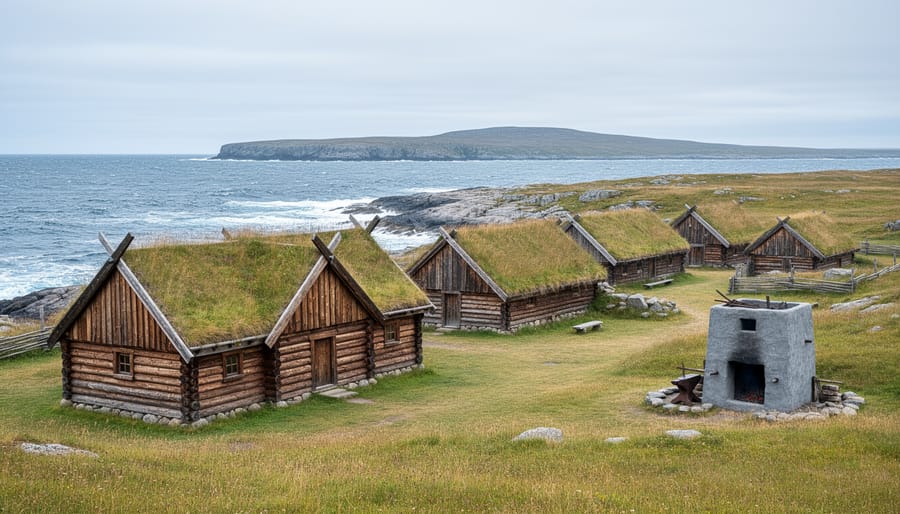
In 1960, Norwegian explorer Helge Ingstad and archaeologist Anne Stine Ingstad unearthed evidence that would rewrite North American history: L’Anse aux Meadows a Viking settlement on Newfoundland’s northern tip that proved Norse seafarers reached Canada around 1000 CE, nearly 500 years before Columbus. The discovery transformed longstanding assumptions about early transatlantic exploration and validated centuries-old Icelandic sagas that scholars had dismissed as myth.
This remote archaeological site revealed eight timber-framed structures, a smithy with iron nails, and artifacts distinctly Norse in origin. Radiocarbon dating confirmed the settlement’s age, while the architectural layout mirrored Viking longhouses found across Greenland and Iceland. For the first time, physical evidence demonstrated that Europeans established a foothold in the Americas during the medieval period.
Today, visitors to this UNESCO World Heritage Site can walk among reconstructed Norse buildings, examine original artifacts in the interpretation center, and stand where Viking explorers once prepared for further journeys into the unknown. The site sits along Newfoundland’s Viking Trail, a scenic coastal route that connects modern travelers to this pivotal chapter in Canadian and world history. Whether you’re drawn by archaeological fascination or simply curious about these early transatlantic pioneers, L’Anse aux Meadows offers a tangible connection to a discovery that changed everything we thought we knew about the New World.
The 1960 Discovery That Changed History
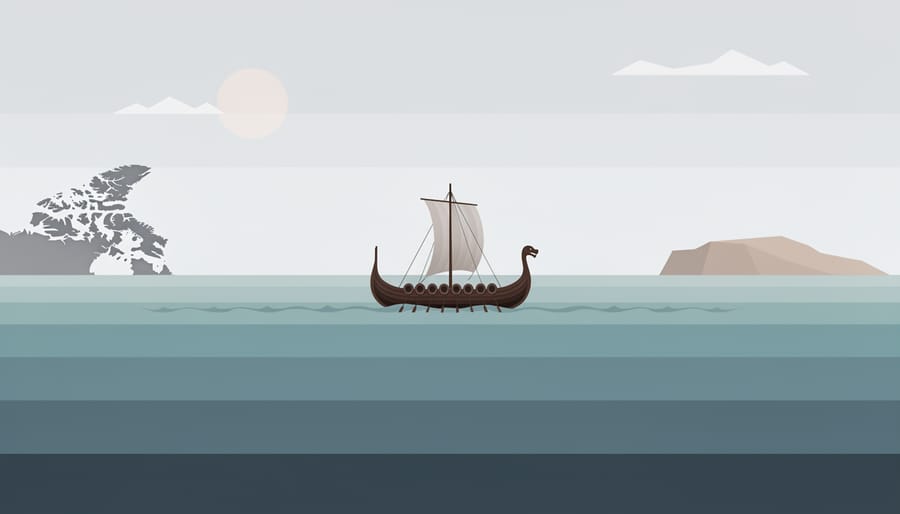
Why Newfoundland: Following the Sagas
The Norse sagas, particularly the Saga of the Greenlanders and Erik the Red’s Saga, provided Helge Ingstad with crucial clues for his search. These medieval texts described voyages from Greenland to a land called Vinland around 1000 CE, mentioning specific geographical features: a northern cape, forests rich with timber, salmon-filled rivers, and wild grapes or berries that gave the region its name.
Ingstad recognized that previous scholars had focused too far south, seduced by the grape reference. He reasoned that “vin” might refer to meadows or grasslands rather than wine grapes, which don’t grow at northern latitudes. The sagas described sailing routes with detailed distances and landmarks that, when plotted carefully, pointed to the northern tip of Newfoundland.
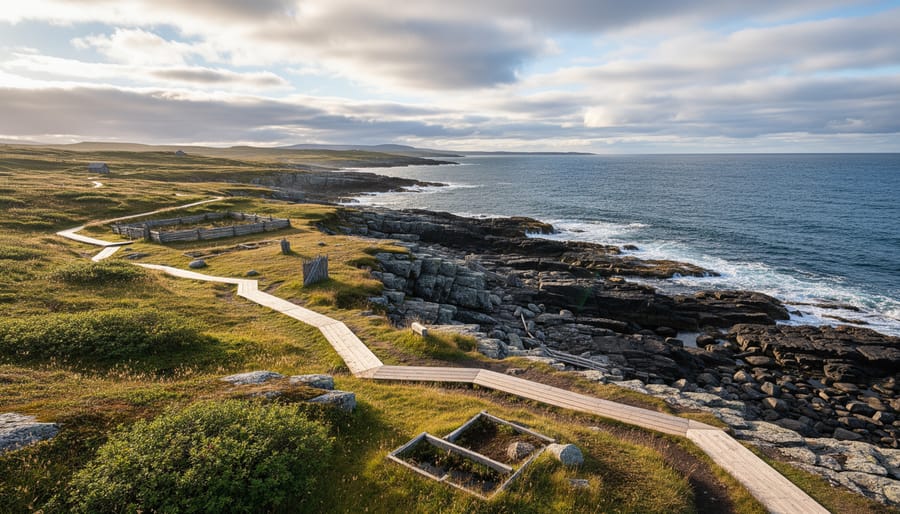
The descriptions matched remarkably well. L’Anse aux Meadows sits at exactly the kind of protected bay the sagas mentioned, surrounded by the timber-rich forests Norse Greenlanders desperately needed. The site offered excellent salmon fishing and berry-picking grounds. Most importantly, it occupied a strategic position as the first major landfall when sailing from Greenland via Baffin Island, exactly as the sagas described the journey.
When local resident George Decker showed Ingstad overgrown ridges near the fishing village in 1960, the Norwegian explorer immediately recognized their potential. The layout and location aligned perfectly with saga descriptions of timber-gathering camps. What seemed like folklore suddenly became a credible archaeological roadmap, leading to one of the twentieth century’s most significant historical discoveries.
What the Evidence Revealed
The excavation at the Norse settlement yielded unmistakable proof of Viking presence. The Ingstads and their team uncovered eight timber-framed turf structures identical to buildings found in Norse Greenland and Iceland. These weren’t Indigenous dwellings. The construction technique, layout, and size matched Viking architecture precisely.
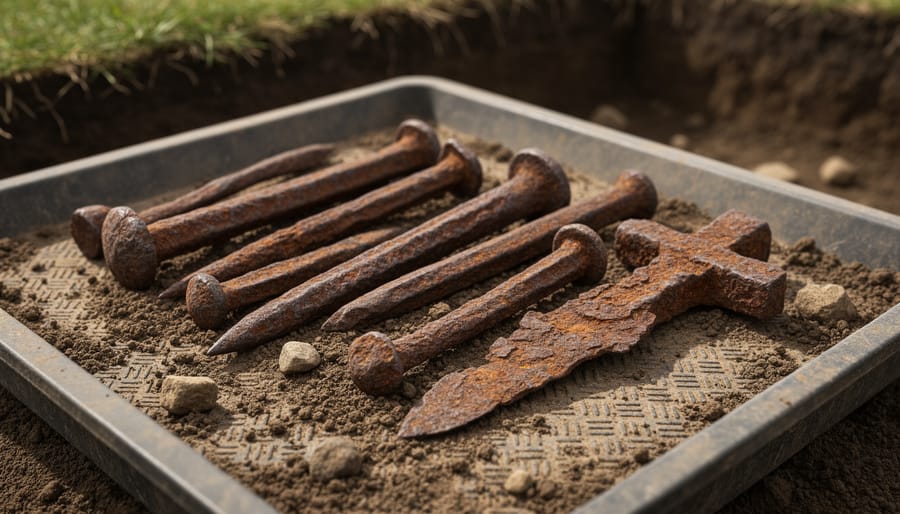
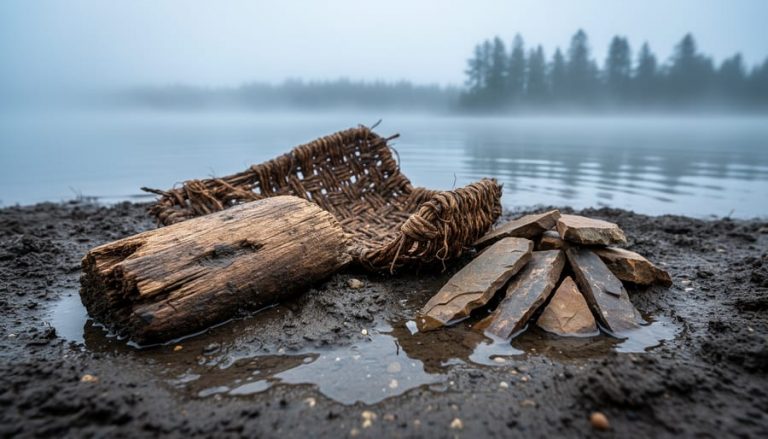
Among the artifacts, a soapstone spindle whorl stood out. This small carved stone, used for spinning wool, was a distinctly Norse tool. Indigenous peoples in the region didn’t spin wool or use such implements. The team also found hand-wrought iron boat nails, slag from iron smelting, and a bronze cloak pin of Norse design.
Radiocarbon dating of charcoal from the hearths placed occupation around 1000 CE, aligning perfectly with saga timelines describing Leif Erikson’s Vinland voyages. Later analysis confirmed the Norse settlement at L’Anse aux Meadows was occupied for only a few years, perhaps a decade at most. The limited midden deposits and wear patterns suggested a small community, maybe 70 to 90 people, used the site as a base camp rather than establishing a permanent colony.
No graves were discovered, supporting the interpretation of temporary occupation. The evidence painted a clear picture: Vikings had reached North America five centuries before Columbus, and this Canadian site proved it conclusively.
Inside the Viking Settlement: What Life Was Like
The Norse settlement at L’Anse aux Meadows was never meant to be permanent. Archaeological evidence points to a small, temporary base camp occupied by perhaps 70 to 90 people at peak use, though likely fewer than 30 wintered there at any one time.
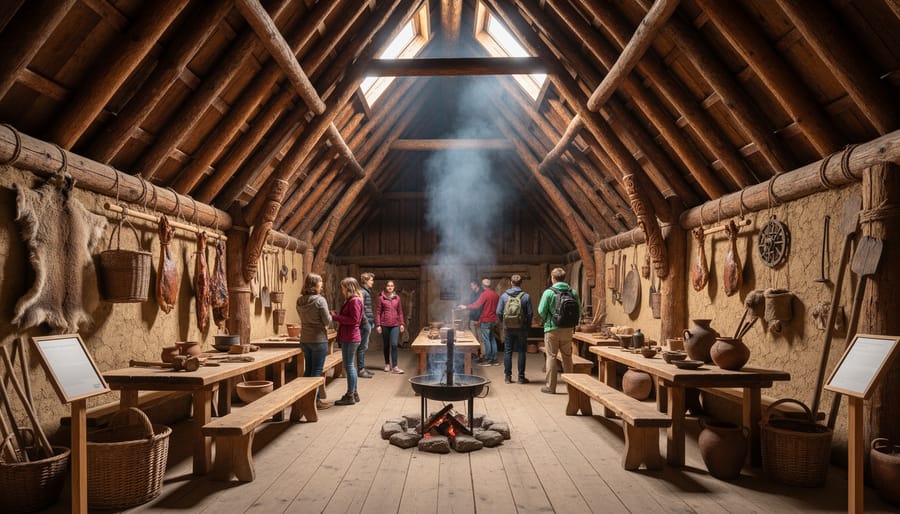
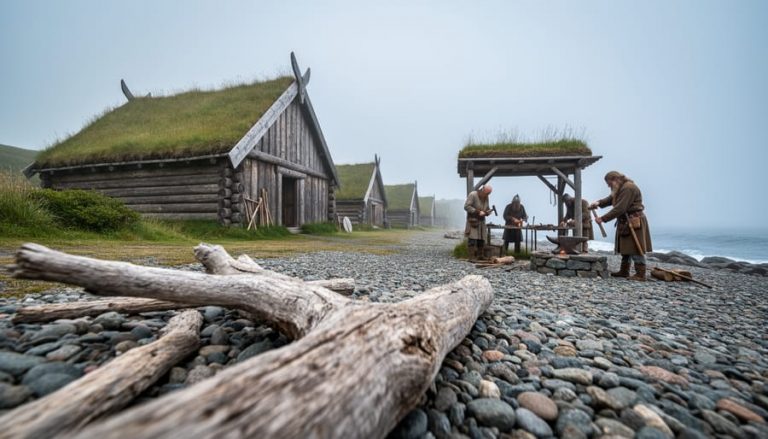
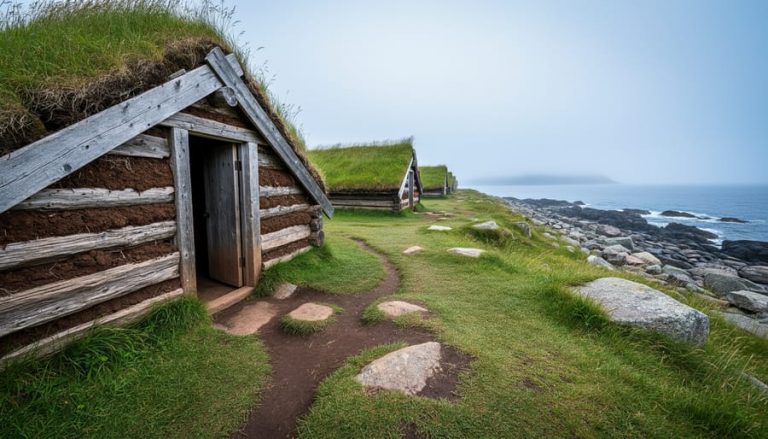
The site consisted of eight timber-frame structures built using techniques identical to those found in Viking-age Iceland and Greenland. Three dwelling halls dominated the settlement, each featuring a central long-fire for heat and cooking. The largest measured approximately 28 by 15 metres, with thick sod walls and a turfed roof that would have kept occupants warm through harsh Newfoundland winters. Inside these halls, raised sleeping benches lined the walls, and a stone ember pit sat near the entrance, a characteristic Norse feature for containing coals overnight.
Beyond the living quarters, the Norse built specialized work buildings. A forge contained a stone anvil and iron slag, where smiths repaired tools and produced nails critical for ship maintenance. Carpentry workshops held wood shavings and discarded planks, suggesting boat repair operations. Most telling was a specialized hut containing a ringed iron pin used for spinning yarn, typical Norse women’s work and strong evidence of both genders living at the site. Hundreds of iron boat nails recovered from the workshops confirm this was a maritime operation focused on ship maintenance and potentially further exploration.
The settlement functioned as a staging area. Stockpiles of butternuts, which don’t grow in Newfoundland but do 700 kilometres south, prove the Norse explored well beyond their base. They felled trees, processed iron from bog ore, and repaired vessels for continued voyages. Charcoal from the hearths and wood remnants show they burned primarily birch and juniper, both locally abundant.
Carbon dating and artifact analysis suggest the Norse occupied L’Anse aux Meadows for perhaps three to ten years around 1000 CE, with sporadic seasonal visits rather than continuous year-round habitation. The minimal accumulation of cultural debris and the absence of refuse mounds typical of longer-term settlements support this brief occupation. When they departed, they salvaged reusable iron and abandoned the timber structures to the elements.
Beyond L’Anse aux Meadows: Other Viking Evidence in Canada
The Point Rosee Investigation
In 2015, satellite imagery analysis sparked excitement when archaeologist Sarah Parcak identified what appeared to be a second Norse site at Point Rosee, on Newfoundland’s southwest coast. The location, roughly 400 miles south of where Vikings landed at L’Anse aux Meadows, showed promising features including what researchers initially interpreted as a possible iron-working hearth. Ground excavations in 2016 uncovered bog iron and charcoal, fueling speculation about Norse metalworking activity.
However, subsequent analysis proved disappointing. The supposed hearth showed no evidence of reaching temperatures required for iron smelting. Carbon dating suggested natural fires rather than human activity. Artifacts that might definitively link the site to Norse occupation simply weren’t there. By 2017, most archaeologists concluded Point Rosee was likely a natural formation or possibly related to Indigenous activity. The investigation illustrated both the promise and challenges of identifying new Viking sites in Canada, where hopeful leads often dissolve under rigorous archaeological scrutiny.
Norse Artifacts Across the Arctic
While L’Anse aux Meadows remains the only confirmed Norse settlement, tantalizing evidence of Viking presence scattered across the Canadian Arctic tells a different story about the extent of Norse exploration. Archaeologists have uncovered Norse artifacts at Indigenous sites spanning thousands of kilometers from Newfoundland, including iron ship rivets, bronze balance scales, and distinctively European-style woven cloth fragments.
The most compelling finds come from sites in the Canadian Arctic Archipelago and northern Labrador, where objects of unquestionable Norse origin have been discovered in contexts dating from the 11th through 13th centuries. At a site on Baffin Island, excavations revealed fragments of Norse yarn spun using techniques unknown to Indigenous peoples, alongside pieces of worked iron consistent with Viking metallurgy. Similar discoveries at other Dorset and Thule culture sites suggest these items arrived through trade networks rather than direct Norse settlement.
What makes these artifacts significant isn’t just their Norse origin, but their distribution pattern. They appear at sites along traditional Indigenous trade routes, indicating the Vikings established exchange relationships with Arctic peoples. Indigenous communities likely obtained these goods through intermediary trading, passing them hand-to-hand across vast distances. This evidence transforms our understanding of Viking-Indigenous contact from isolated encounters at a single outpost to a broader, more complex network of cultural exchange spanning Canada’s northern reaches.
Visiting L’Anse aux Meadows Today
Visiting the UNESCO site where Vikings first stepped onto North American soil offers an immersive journey into Norse exploration. Located on Newfoundland’s remote northern peninsula, L’Anse aux Meadows National Historic Site sits roughly 430 kilometers from Deer Lake, requiring commitment but rewarding visitors with an authentic encounter with history.
The site operates seasonally, with facilities and programming varying throughout the year:
| Season | Hours | Admission | Programming |
|---|---|---|---|
| June-September | 9 AM – 6 PM daily | $11.70 adults | Full interpretive staff, costumed demonstrations |
| October-May | Limited/by appointment | Free off-season | Self-guided grounds access only |
Plan three to four hours for a thorough visit. Start at the modern interpretation center, where artifacts recovered from excavations tell the story of both discovery and settlement. You’ll see iron rivets that once held Viking ships together, the bronze cloak pin that confirmed Norse presence, and reconstructed tools that reveal daily activities.
Three full-scale Norse sod buildings stand near the original excavation sites, built using authentic techniques and materials. Costumed interpreters demonstrate iron smelting, woodworking, and wool preparation during peak season. Step inside the dark, smoky interiors to understand how eight structures once housed perhaps 70 Norse explorers who wintered here.
Walking trails lead to the actual archaeological sites, marked and protected but visible, where post molds and foundation trenches remain from structures built over a thousand years ago. Interpretive signs explain what archaeologists found in each location.
The gift shop stocks quality books on Norse exploration and locally crafted items. Staff can direct you to nearby Norstead, a living history Viking village that complements your visit with hands-on activities and replica ship tours.
Weather changes rapidly on this exposed coast. Bring layers, rain gear, and sturdy footwear even in summer.
Expert Perspective: An Archaeologist’s View
Dr. Sarah Parcak, a space archaeologist who led the Point Rosee investigation and continues research on Norse North American sites, offers perspective on why L’Anse aux Meadows remains archaeology’s gold standard for Viking discoveries in Canada.
“What makes the Canadian discovery of L’Anse aux Meadows so remarkable isn’t just that we found Vikings in North America,” Dr. Parcak explains. “It’s that the site gave us a complete picture, buildings, artifacts, bog iron extraction, even the butternuts that proved they explored southward. Most archaeological sites give you fragments. This one handed us a story.”
The 1960 discovery fundamentally changed how archaeologists approach Norse exploration. Before L’Anse aux Meadows, the sagas were treated as mythology. After, they became viable research tools. “We now take those texts seriously as geographical guides,” Dr. Parcak notes. “But we’ve also learned they compress time and conflate multiple expeditions into single narratives. Disentangling fact from storytelling remains our biggest interpretive challenge.”
Current research focuses on questions the original excavation couldn’t answer. How many voyages reached North America? Did the Norse establish temporary camps elsewhere that left minimal traces? Why did they abandon a settlement with clear strategic value?
“The short occupation puzzles us,” admits Dr. Parcak. “They had timber, fish, iron ore, resources Iceland desperately needed. Yet they stayed maybe a decade, perhaps just a few seasons. The sagas mention conflict with Indigenous peoples, which is plausible. But we suspect the logistics of maintaining supply lines across the North Atlantic proved untenable for permanent colonization.”
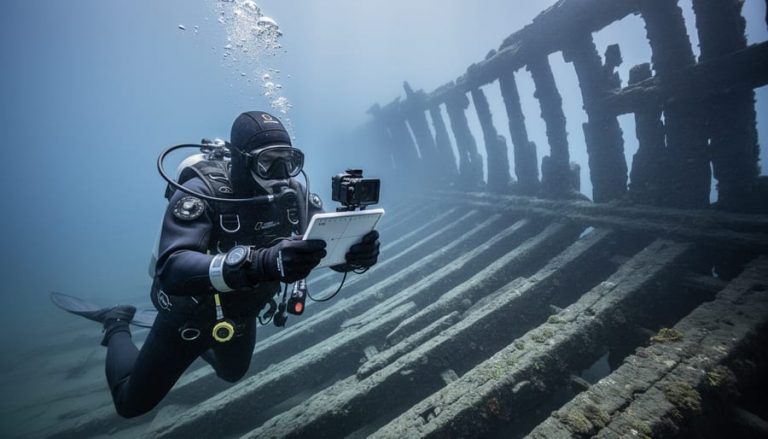
New technologies are revolutionizing the search for additional Viking sites. Satellite imagery, ground-penetrating radar, and environmental DNA analysis can detect human activity invisible to traditional surveys. “We’re essentially re-surveying the entire North Atlantic coastline with 21st-century eyes,” Dr. Parcak says. “I’d bet we haven’t found the last Viking site in Canada.”
She emphasizes that L’Anse aux Meadows also transformed Indigenous archaeology. “The Norse didn’t arrive in an empty land. Understanding this contact period, how Indigenous peoples responded to these strangers, is equally important. That’s where current research is heading, toward a more complete picture of this remarkable cultural encounter.”
Planning Your Viking Discovery Journey: Recommended Itinerary
A proper Viking discovery journey requires at least four days to meaningfully explore the Vikings in Newfoundland heritage while accounting for travel time and the remote location of L’Anse aux Meadows.
- Day 1: Arrive in St. John’s. After landing, spend the afternoon at The Rooms provincial museum, which contextualizes Newfoundland’s Viking chapter within broader provincial history. Their Viking exhibition includes artifacts on loan from L’Anse aux Meadows and explains Norse navigation techniques. Stay overnight in St. John’s to adjust after travel and enjoy the harbor-side restaurants. Budget accommodations: $120-180 per night.
- Day 2: Drive north toward L’Anse aux Meadows (eight hours, 740 kilometers). Leave early and plan a midday stop in Gander or Deer Lake to break the journey. The route follows the Viking Trail (Route 430), which winds through dramatic coastal scenery. Arrive in St. Anthony by evening and check into lodging there, as it’s the nearest town with reliable services. Options range from B&Bs ($100-150) to the Grenfell Heritage Hotel ($180-220).
- Day 3: Full day at L’Anse aux Meadows National Historic Site. Arrive when it opens at 9 AM to beat tour buses. Allocate three to four hours for the visitor center exhibits, guided tours of the archaeological site, and exploration of the reconstructed Norse buildings where costumed interpreters demonstrate period crafts. In the afternoon, visit Norstead Viking Village five kilometers south, a living history site with a full-scale replica knarr ship and workshops showing iron smelting and weaving. Return to St. Anthony for a second night.
- Day 4: Morning visit to Burnt Cape Ecological Reserve (45 minutes north) to see the limestone barrens landscape the Norse encountered. Then begin the return drive south, stopping at Port au Choix National Historic Site (two hours from St. Anthony) to explore 4,000 years of Indigenous maritime cultures that preceded and overlapped with Norse contact. Overnight in Deer Lake or Rocky Harbour depending on your departure schedule.
June through September offers the most reliable weather and site access, though fog remains common even in summer. Book accommodations in St. Anthony well ahead, as options are limited. Gas stations become sparse north of Deer Lake, so fill up regularly. The Viking Trail has cell service gaps, so download offline maps beforehand.
Consider adding a fifth day for whale watching tours from St. Anthony or exploring Gros Morne National Park on the return journey, which showcases the geological context of Norse exploration along these ancient shores.
The Norse settlement at L’Anse aux Meadows stands as more than an archaeological site. This Canadian discovery rewrote centuries of accepted history, proving that Vikings reached North America five centuries before Columbus set sail. What began as a systematic search guided by ancient sagas became definitive proof that transformed our understanding of pre-Columbian exploration and contact between continents.
Today, ongoing research continues to build on what the Ingstads uncovered in 1960. Each season brings new questions about how far the Norse traveled, how long they stayed, and what relationships they formed with Indigenous peoples already thriving across the continent. The site remains a living laboratory where archaeology meets cultural heritage.
Standing among the reconstructed Norse buildings on Newfoundland’s windswept coast connects you directly to this pivotal moment in exploration history. You walk the same ground where Viking explorers built their halls, repaired their ships, and ultimately decided this distant shore was too far from home. It’s a reminder that history often unfolds in remote places, waiting for someone persistent enough to look. This UNESCO World Heritage Site belongs to Canada’s story and the world’s, preserving evidence of courage, ambition, and the human drive to explore beyond known horizons.

+ There are no comments
Add yours